Test Pyramid
The Test Pyramid: A Strategic Deep Dive for Modern QA Teams
The Test Pyramid is not a diagram you hang on a wall.
It is an economic model for engineering trust into software.
Most teams claim to follow the Test Pyramid.
Very few actually practice it.
This post breaks the pyramid down at a strategy level, not a tutorial level.
We’ll go deep into:
- What each layer truly represents
- Where teams go wrong
- How to enforce it at scale
- When to bend (but not break) the model
Real-world trade-offs senior testers must understand
The Test Pyramid at a Glance
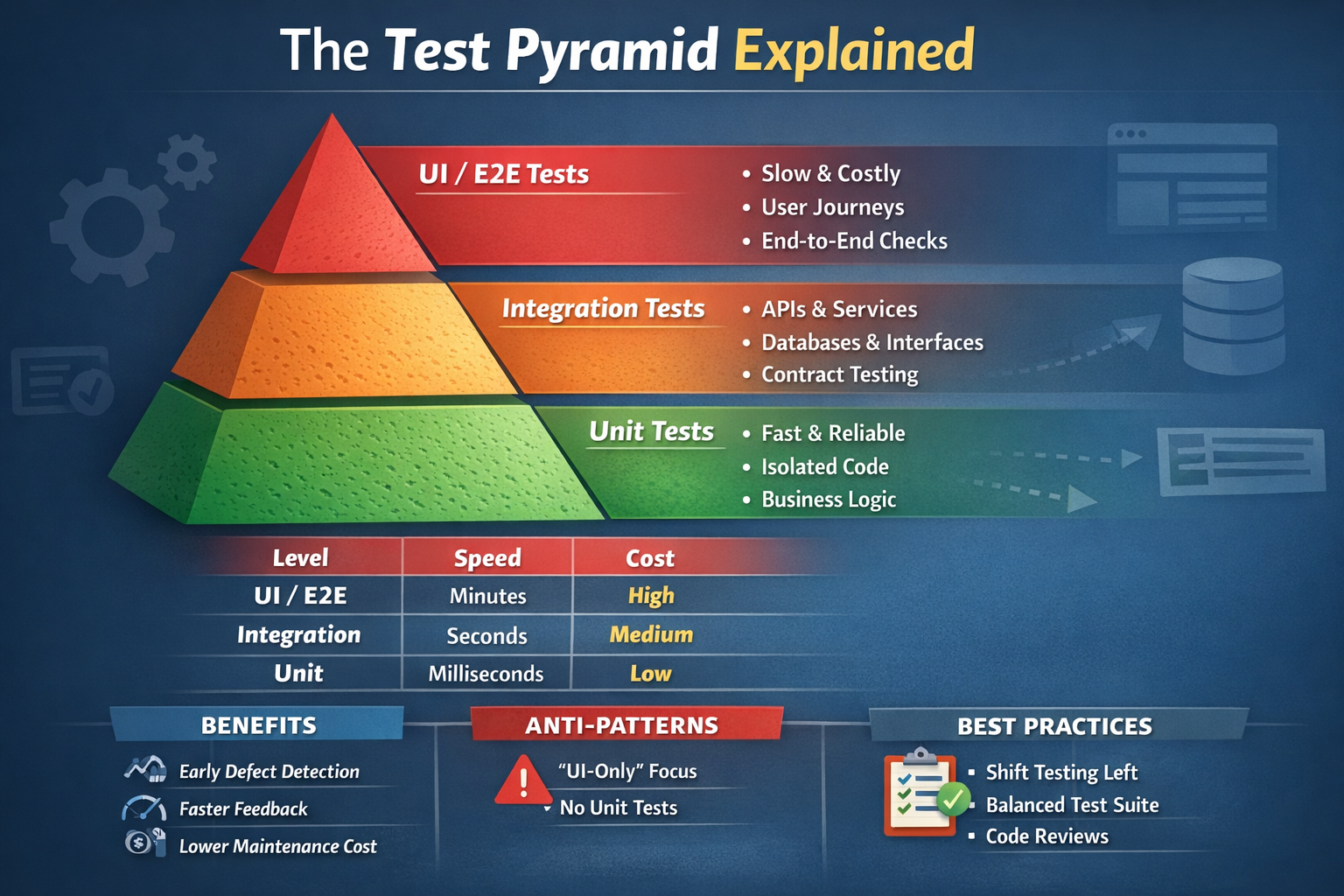
1. What the Test Pyramid Really Solves
The Test Pyramid exists to balance four forces:
- Speed of feedback
- Cost of failure
- Maintenance effort
- Confidence in releases
Every testing decision is a trade-off between these forces.
The pyramid optimizes for early failure detection at the lowest possible cost.
2. The Three Layers (With Intent, Not Labels)
2.1 Unit Tests – The Foundation of Truth
Unit tests are not about coverage percentages.
They are about locking business logic into executable documentation.
Characteristics of a True Unit Test
- Tests one logical unit (method / function / class)
- No database
- No network
- No filesystem
- Deterministic (same input → same output)
- Executes in milliseconds
If a test needs:
- Selenium
- Docker
- API calls
…it is not a unit test.
Why Unit Tests Matter Strategically
- They catch defects before integration
- They make refactoring safe
- They force better design (low coupling, high cohesion)
- They reduce dependency on slower tests
A system without strong unit tests becomes change-resistant.
2.2 Integration Tests – Where Most Bugs Live
Integration tests validate collaboration between components.
This layer answers the most important question in testing:
“Does my code still work when reality is involved?”
What Integration Tests Cover
- API to database interaction
- Service-to-service communication
- Message queues and events
- Data mapping and transformations
- Contract validation
Why This Layer Is Often Undervalued
Many teams jump directly from unit tests to UI tests.
That gap is dangerous.
Most production defects are:
- Data-related
- Contract-related
- Configuration-related
All of them live here, not in the UI.
A strong integration layer drastically reduces the need for excessive UI automation.
2.3 End-to-End (UI) Tests – Confidence, Not Coverage
UI tests simulate real user workflows, not edge cases.
They should answer:
- Can a user log in?
- Can a user complete a critical flow?
- Does the system work end-to-end?
What UI Tests Should NOT Do
- Validate business logic already tested at unit level
- Cover every negative scenario
- Replace integration tests
UI tests are:
- Slow
- Fragile
- Expensive to maintain
Use them like a scalpel, not a hammer.
If your test suite fails more often due to UI flakiness than real bugs, the pyramid is inverted.
3. The Economics of the Pyramid
| Layer | Execution Speed | Maintenance Cost | Defect Detection |
|---|---|---|---|
| Unit | Milliseconds | Low | Very Early |
| Integration | Seconds | Medium | Early |
| UI / E2E | Minutes | High | Late |
Every defect caught later costs exponentially more:
- More debugging time
- More environments involved
- More people blocked
The pyramid minimizes wasted human time, not just execution time.
4. How Teams Accidentally Invert the Pyramid
Common anti-patterns seen in real projects:
- “Users use the UI, so we test everything through UI”
- Heavy Selenium suites with minimal backend coverage
- Automation owned only by QA, not developers
- No unit tests due to “time constraints”
- Mocking everything until nothing is real
An inverted pyramid creates:
- Slow pipelines
- Flaky tests
- Low trust in automation
- Manual verification before every release
That is not quality. That is fear.
5. Enforcing the Pyramid in Real Teams
5.1 Make Test Placement a Review Rule
During code reviews:
- Feature code without unit tests → reject
- UI test added without lower-level coverage → question it
Testing strategy must be reviewable, not optional.
5.2 Define Ownership Clearly
A healthy model:
- Developers: Unit + Integration tests
- QA: Test strategy, risk analysis, critical E2E flows
- Team: Shared responsibility for quality
When QA owns all automation, the pyramid collapses under its own weight.
5.3 Measure the Right Metrics
Stop tracking:
- Number of test cases
- Automation percentage
Start tracking:
- Defect leakage to production
- Time to detect failures
- Flaky test rate
- CI pipeline duration
What you measure is what the team optimizes.
6. Shifting Left Is Not a Buzzword
True shift-left means:
- Test scenarios discussed during story grooming
- Edge cases reviewed before coding
- API contracts validated early
- Testability considered in design
Late testing is not testing — it’s forensics.
7. When the Pyramid Needs Adjustment
The pyramid is a model, not a religion.
Valid reasons to adapt:
- Legacy systems with no unit coverage
- UI-heavy products with minimal backend logic
- Early-stage products validating UX rapidly
In such cases:
- Start with integration tests
- Stabilize critical paths
- Gradually push logic downward
- Improve design incrementally
Evolution beats revolution.
8. The Modern Test Pyramid (2025 Reality)
Today’s mature pyramids often include:
- Contract testing between services
- Consumer-driven tests
- Synthetic monitoring
- Production observability checks
Testing does not end at deployment.
Production is the final feedback loop.
9. Advantages of a Healthy Test Pyramid
- Faster CI/CD pipelines
- Earlier defect detection
- Lower maintenance cost
- Higher release confidence
- Reduced dependency on manual testing
It turns testing from gatekeeping into engineering.
10. Limitations and Honest Trade-offs
- Requires developer discipline
- Needs testable architecture
- Initial investment is non-trivial
- Poorly designed unit tests add noise
The pyramid works only when engineering quality is valued culturally, not just procedurally.
Conclusion: The Pyramid Is a Mindset
The Test Pyramid is not about tools, frameworks, or diagrams.
It is about:
- Respecting feedback loops
- Understanding cost of change
- Designing for testability
- Valuing human time
Teams that master the pyramid:
- Ship faster
- Debug less
- Sleep better
- Argue with data, not opinions
Quality is not added at the end.
It is designed from the bottom up.